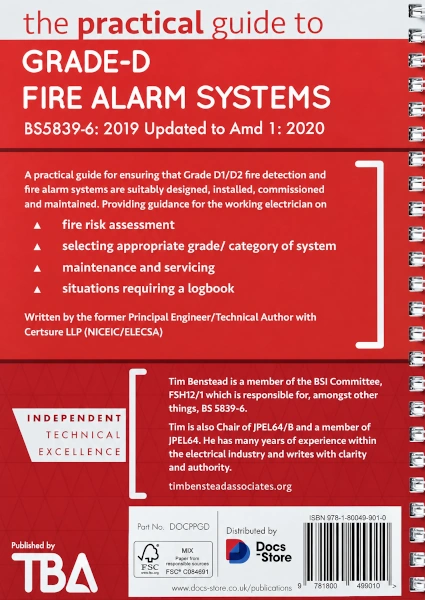
The Practical Guide to Grade D Fire Alarm Systems
Practical, focused guidance for professionals responsible for Grade D fire detection and fire alarm systems.
The Practical Guide to Grade D Fire Alarm Systems has been written to support electricians in understanding their roles and responsibilities when designing, installing, commissioning and maintaining Grade D fire detection and fire alarm systems.
Focused specifically on Grade D1 and Grade D2 systems, the guide provides practical support for ensuring systems are suitably designed, installed, commissioned and maintained.
Written in a clear and concise style, it brings together guidance covering competence, fire risk assessment, system selection, design, installation, commissioning, maintenance and servicing, helping readers understand both what is required and the context in which the work should be carried out.
Whether you are working as a contractor or designer, or are responsible for domestic premises as a landlord or housing manager, this guide provides a focused reference for understanding the responsibilities involved in Grade D fire alarm system work.
What This Practical Guide Covers
- Fire risk assessment
- Selecting the appropriate grade and category of system
- Grade D1 and Grade D2 fire detection and fire alarm systems
- System design
- Installation
- Commissioning
- Maintenance and servicing
- Situations requiring a logbook
- Understanding competence, roles and responsibilities
Why Choose The Practical Guide to Grade D Fire Alarm Systems?
- Written specifically to support the working electrician
- Provides practical guidance across the complete process from design through to maintenance
- Focused on Grade D1 and Grade D2 fire detection and fire alarm systems
- Helps readers understand their individual roles and responsibilities
- Covers the selection of an appropriate grade and category of system
- Provides guidance on fire risk assessment
- Addresses maintenance, servicing and logbook requirements
- Written in a clear and concise style for practical use
Who is This Guide For?
The guide is written for those responsible for the design, installation, commissioning, maintenance or management of Grade D fire detection and fire alarm systems.
- Electricians
- Electrical contractors
- System designers
- Landlords
- Housing managers
By addressing the responsibilities associated with each role, the guide helps provide the context in which Grade D fire alarm system work should be carried out.
A Strong Focus on Competence and Responsibility
The concept for the publication developed from a recognised need for the industry to demonstrate competence following the Grenfell Tower tragedy.
The Hackitt Report highlighted concerns surrounding a perceived “race to the bottom” within the industry and reinforced the principle that people should not simply feel safe in their homes, but should actually be safe.
Against this background, the guide places clear emphasis on competence, responsibility and appropriate working practices throughout the design, installation, commissioning and maintenance of Grade D systems.
About the Author
The guide is written by Tim, former Principal Technical Author of the NICEIC.
Tim is a member of JPEL64, Chair of JPEL64/B and has been a member of FSH12/1, the BSI committee responsible for BS 5839-1 and BS 5839-6, for fifteen years.
His experience provides a strong understanding of the concerns faced by contractors and those responsible for domestic premises.
The book‘s design and illustrations were produced by Alex Whitworth, who also created artwork for NICEIC publications.
Practical Guidance from Design to Maintenance
Grade D fire alarm work involves more than installing equipment. It requires an understanding of fire risk, appropriate system selection, competence, commissioning, ongoing maintenance and the responsibilities of everyone involved.
This guide brings those considerations together in one dedicated publication, giving electricians and those responsible for domestic premises a practical reference covering the full lifecycle of Grade D1 and D2 fire detection and fire alarm systems.