🍃 Who is the Airflow Mensura Hood for?
Whether you’re an electrician checking an extractor fan, a ventilation installer setting up an MVHR system or a commissioning engineer recording airflow, you need to know what the finished installation actually delivers.
The Airflow Mensura Powered Flow Hood measures supply and extract airflow while compensating for the resistance introduced by the measuring equipment. It helps you compare measured performance with the installation’s design requirements and identify where adjustments may be needed.
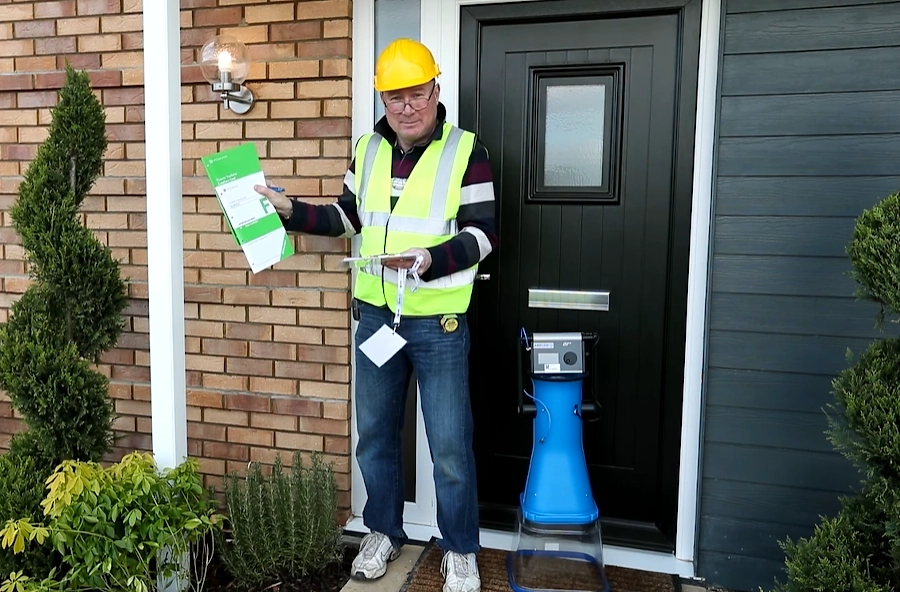
Airflow Mensura Powered Flow Hood: For the professionals who put ventilation performance to the test.
🏠 Why airflow measurement matters in modern homes
As homes become more airtight, a planned ventilation strategy becomes increasingly important. Cooking, bathing and everyday occupancy generate moisture and indoor pollutants that ventilation needs to remove.
The system may use:
- Intermittent extraction: Local fans remove air when needed, with background ventilators providing a route for replacement air
- Continuous mechanical extraction: Fans run at a lower background rate, with higher extraction available when demand increases
- Mechanical ventilation with heat recovery (MVHR): A balanced system extracts air from wet rooms, supplies outdoor air to habitable rooms and transfers heat between the two air streams
Whatever the arrangement, a fan's published performance does not tell you exactly what the completed installation delivers. Measuring at the terminals helps you compare actual airflow with the design requirements and identify where further investigation or adjustment is needed.
🏭 Who are Airflow?
Airflow Developments was founded in 1955 by Alexander Conner Wilson in High Wycombe. A fan engineer, Wilson developed a measuring instrument to support his fan-testing work before establishing the company with his wife, Nancy.
That connection between moving air and measuring it remains relevant today. With more than 70 years of history, Airflow's background spans ventilation equipment and the instruments used to assess its performance.
🛠️ What products do Airflow sell?
Airflow's portfolio covers several stages of the ventilation process, including:
- iCON extractor fans for intermittent domestic ventilation
- iCONstant fans for decentralised continuous mechanical extract ventilation
- Adroit MVHR systems for residential applications
- Duplexvent and DUPLEXbase systems for commercial heat-recovery ventilation
- Airflow measurement instruments, including the Mensura Powered Flow Hood
🤝 Who have Airflow worked with?
Airflow's wider ventilation projects include:
- Charlie Luxton's Black Barn Studios in Oxfordshire: A sustainable office project incorporating an Airflow MVHR system
- Solarcrest: A residential retrofit partnership in Hertfordshire involving MVHR with cooling
- London South Bank University: Commercial MVHR installations using Duplexvent Multi Eco equipment at its Southwark site
These examples show the breadth of Airflow's ventilation work across homes, workplaces and education.
🔎 Why choose a powered flow hood?
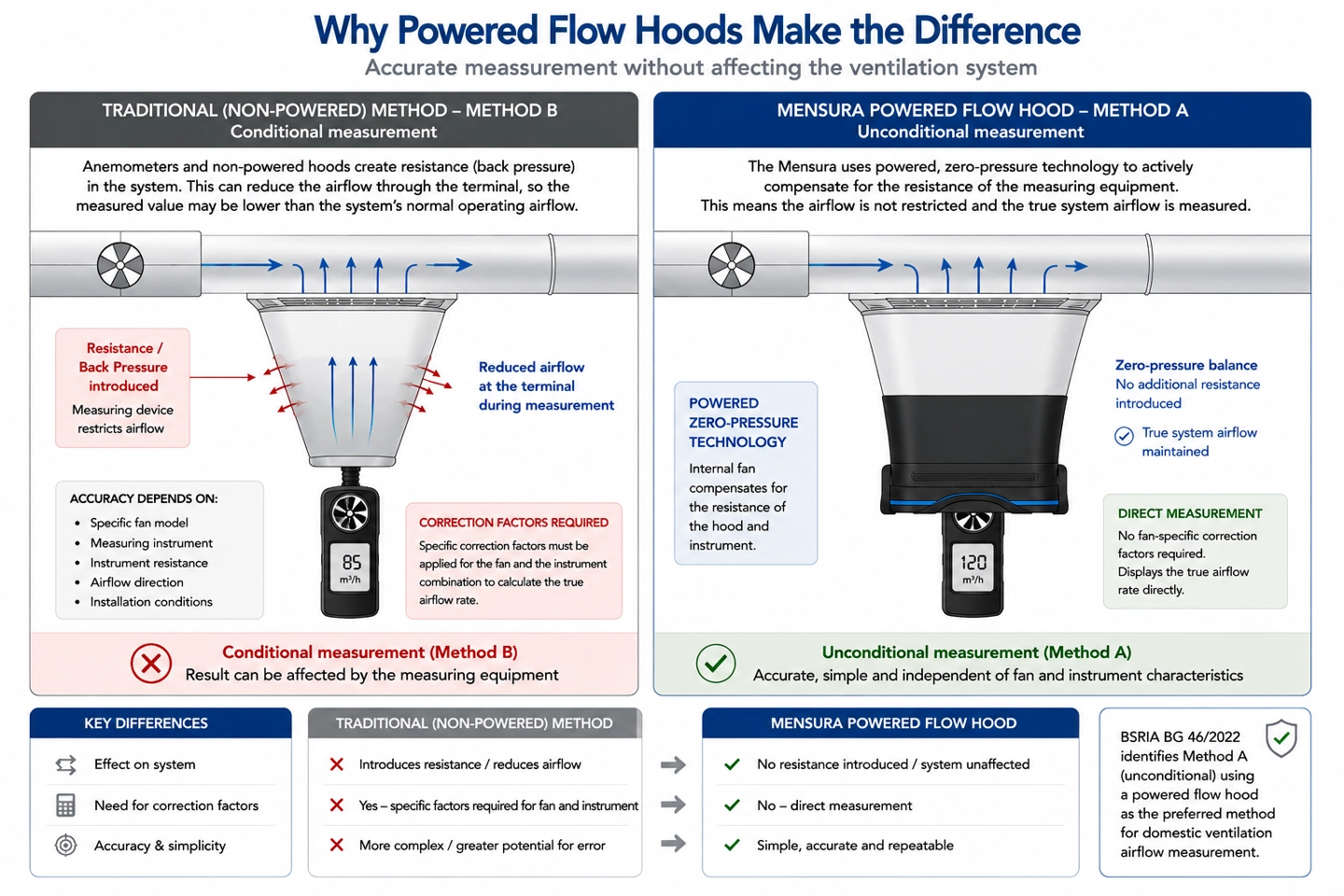
Putting measuring equipment over a ventilation terminal can change the airflow you are trying to measure. The hood and instrument introduce resistance, which can reduce the flow through the terminal and affect the result.
The Airflow Mensura Powered Flow Hood tackles this with powered zero-pressure compensation. It detects the pressure difference created by the measuring equipment and adjusts its internal fan to counteract it.
The practical benefit is a direct airflow measurement that minimises the instrument's influence on the ventilation system, without the fan- and instrument-specific resistance correction factors used in conditional testing.
⚖️ Understanding BSRIA’s three measurement methods
BSRIA's BG 46/2022 guide to measuring domestic ventilation airflow rates describes three approaches: unconditional, conditional and minimum benchmark measurement.
| Method |
How it works |
What it means for the installer |
| Method A — Unconditional |
A powered flow hood actively compensates for the resistance introduced by the measuring equipment. |
Provides a direct measurement without fan- and instrument-specific resistance correction factors. This is the approach used by the Mensura. |
| Method B — Conditional |
Equipment such as a vane anemometer and hood is used, with the effects of the instrument and fan characteristics taken into account. |
Requires the appropriate correction factors for the fan and measuring equipment. |
| Method C — Minimum benchmark |
Provides a limited benchmark check for certain intermittent extract fans. |
It is not intended to provide an accurate measurement of the actual airflow. |
For electricians and ventilation installers working with different fan models, the Mensura’s powered approach removes the need to identify and apply the resistance correction factors associated with Method B.
“Unconditional” describes the measurement method. Correct hood positioning, suitable measurement accuracy and appropriate calibration remain essential.
🎥 Why ventilation matters in new builds — and how the Airflow Mensura Hood helps
🧰 What does the Airflow Mensura Hood offer on site?
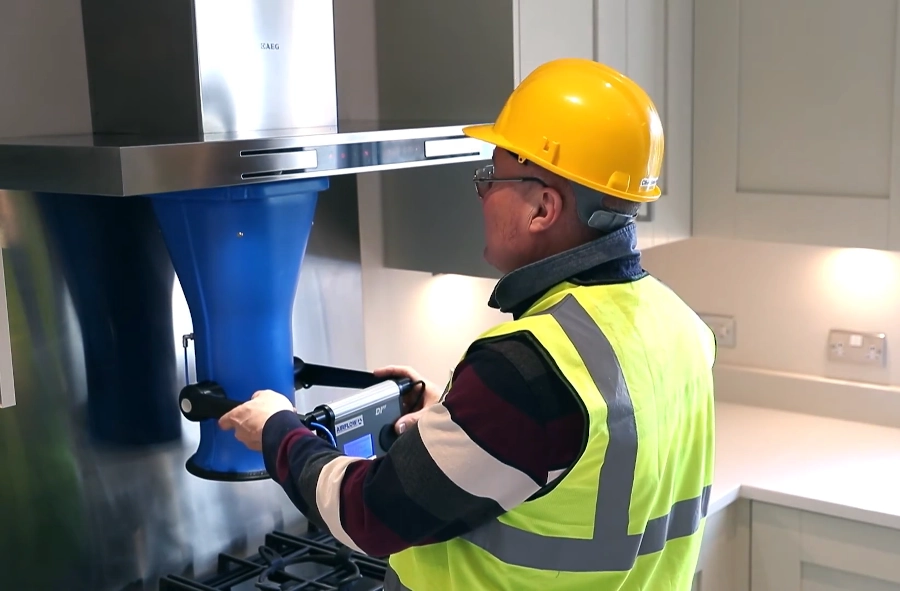
From measuring extract airflow at the cooker hood…
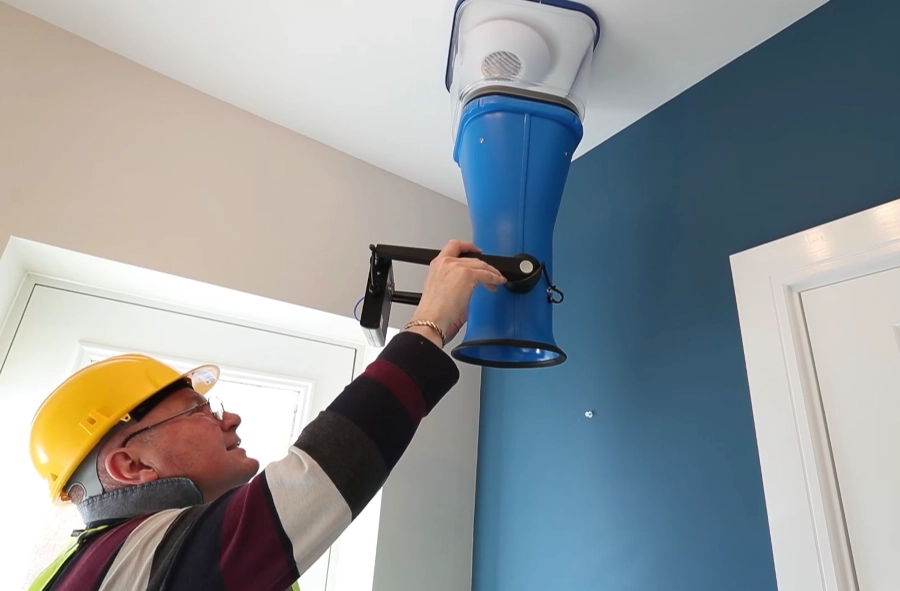
…to checking utility-room extraction against the installation’s airflow requirements.
🔄 Supply and extract testing with one instrument
The Mensura automatically detects airflow direction. You can move between supply and extract terminals without turning the instrument around or changing its configuration.
That is particularly useful when checking MVHR systems, where both sides of the installation need measuring.
🎛️ Adjustable positioning and straightforward controls
The adjustable arms and rotating display help you position the instrument while keeping the reading visible. A single scroll-and-select control provides access to its functions.
An audible signal indicates that the measurement is complete. Waiting for that completed result avoids recording a changing value while the instrument is still measuring.
📊 Key specifications at a glance
| Features |
Airflow Mensura Powered Flow Hood |
| Airflow measurement range |
10–400 m³/h, approximately 2.8–111.1 l/s |
| Stated airflow accuracy |
±3% of reading ±1 m³/h |
| Airflow direction |
✓ Automatically detects supply and extract |
| Selectable airflow units |
m³/h, l/s and CFM |
| Nominal measurement time |
Less than 30 seconds; actual timing depends on conditions |
| Power supply |
Four 1.2 V AA NiMH rechargeable batteries, 2,450 mAh |
| Battery-life reference |
Approximately eight hours while measuring 75 m³/h |
| Instrument weight |
2.9 kg, excluding batteries and transport case |
| Protection rating |
IP20; protect the instrument from water |
Match the accuracy requirement to your actual test points. A measurement range alone does not establish suitability for every commissioning task. Check the required accuracy and calibration coverage, particularly when measuring low airflow rates.
📋 Keep results organised by building, room and terminal
The Mensura’s SD-card storage and DIFFiner PC software provide a way to organise measurements around the job.
You can prepare projects with buildings, rooms and individual terminals, then save readings against the relevant locations. The software supports reviewing measured and design airflow, producing reports and exporting results to Microsoft Excel.
For commissioning work involving several rooms or properties, that structure helps keep the readings connected to the installation they describe. Confirm compatibility with your computer and operating system when specifying the package.
Keep each reading connected to the right room and terminal.
📦 Choose the right hood and package
The standard package includes a transparent AT-242 hood, rechargeable batteries, charger, a 2 GB SD card and transport case.
Optional larger hoods include 400 × 400 mm and 600 × 600 mm versions. Choosing the appropriate hood helps you cover the terminal properly, but a larger hood does not increase the instrument’s maximum measurement range.
If your require calibration please include it in your quotation request (alongside any additional hoods or accessories).
Provide the terminal dimensions, expected flow rates and required calibration coverage so the complete package can be checked against your work.
🏠 Ventilation legislation and compliance in new builds
England: testing is part of the commissioning process
For new dwellings in England, Part F covers adequate ventilation, with commissioning requirements for fixed mechanical ventilation systems where applicable. Regulation 42 requires mechanical ventilation airflow testing and notification of the results within five days of the final test.
For projects following the 2021 Approved Document F guidance, the measuring device should have a proprietary hood attachment, an accuracy of ±5%, and calibration within the previous 12 months at a UKAS-accredited calibration centre.
The practical point is that commissioning involves more than obtaining a number. The equipment, test setup, records and installation all need to meet the applicable requirements.
📅 What changes under the 2026 guidance?
England’s 2026 Approved Document F takes effect on 24 March 2027 for work other than higher-risk building work, and 24 September 2027 for higher-risk building work, subject to transitional arrangements.
Its airflow-testing guidance calls for:
- Powered flow hoods for continuous supply and extract measurements.
- Vane anemometers as an alternative for intermittent extract fans.
- The instrument and hood to be calibrated together within 12 months at a UKAS-accredited centre.
- Calibration covering at least 4 l/s through to the system's maximum design airflow.
- ±5% accuracy, with recorded readings averaged over at least 10 seconds.
A powered hood addresses the measurement-method requirement. Confirm the Mensura’s accuracy at your intended test points, calibration coverage and recording procedure before specifying it for a particular compliance task.
Requirements differ across the UK
England's Approved Document F should not be treated as UK-wide guidance. Wales has its own Approved Document F, Scotland uses its Building Standards Technical Handbooks, and Northern Ireland provides ventilation guidance in Technical Booklet K. Check the requirements and transitional arrangements applying to the project’s location.
Regulatory information was checked on 28 October 2026. Before starting work, confirm the legislation, guidance and any transitional arrangements that apply to your project and its location.
📚 Explore further ventilation guidance
The Airflow Knowledge Centre brings together resources on residential ventilation, installation and commissioning, indoor air quality, and sectors including schools and education. It provides a useful starting point for exploring the guidance relevant to your projects.
✅ Getting useful results from your flow hood
Good preparation helps you get useful measurements from the Mensura.
Allow the instrument to adjust to the ambient temperature and carry out its pressure-sensor zero adjustment as directed. Position the hood so it fully covers the terminal, with a secure seal and an unobstructed airflow path.
Keep the display clear of the instrument’s air opening, wait for the measurement-complete signal and save the result against the correct location.
Where a reading falls short of the design requirement, investigate the installation and settings before completing commissioning. The hood provides the measurement; any system adjustments remain part of the installer's work.
❓ Frequently Asked Questions (FAQ)
Can the Airflow Mensura Hood be used for MVHR commissioning?
A. It measures both supply and extract airflow and automatically detects the direction, making it relevant to MVHR testing. Check that the required flow rates, measurement accuracy and terminal sizes are covered by your chosen instrument, hood and calibration package.
Does the instrument’s on-site “calibration” function replace laboratory calibration?
A. No. The menu function adjusts the pressure sensor’s zero point for the operating conditions. It does not replace the separate calibration needed to verify the instrument’s measurement performance.
Can I use ordinary AA batteries?
A. The Mensura requires the specified rechargeable NiMH batteries. Ordinary alkaline batteries are unsuitable and can restrict performance or cause the instrument to shut down. Use the battery type and capacity specified for the instrument.
Can it measure larger commercial grilles?
A. Optional larger hoods are available, but suitability depends on the grille dimensions, access and expected airflow. The instrument’s maximum range remains 400 m³/h, regardless of hood size.
📞 Find the right Airflow Mensura package for your work
If you need to measure domestic supply and extract airflow, compensate for the resistance introduced by your measuring equipment and keep results organised, the Airflow Mensura Powered Flow Hood is worth considering.
Tell us about the ventilation systems you test, the airflow rates you expect and the terminal sizes you encounter. Simply specify any extras when asking for your quotation.
Request a quotation or contact an AcutestDirect product specialist to discuss the Mensura 90001033, confirm the appropriate accessories and calibration, and check current availability.