Choosing the Right Extech Moisture Meter: MO50A vs MO55A vs MO57A
Moisture meters are essential tools for anyone working in building inspection, restoration, or woodworking. Whether you're tracking down a hidden leak or checking timber before installation, choosing the right meter can make a big difference in both accuracy and efficiency.
In this guide, we’ll look at three popular models from Extech:
We’ll also look at the Extech BR95-RH External Temperature and Humidity Sensor, which adds environmental monitoring to your inspection toolkit.
All three moisture meters are designed for wood and building materials, but they differ significantly in how they measure moisture—and where they perform best.
Understanding the key differences
Before diving into the specs, it’s worth understanding the two main measurement methods:
- Pin (invasive): Measures electrical resistance between probes for accurate % moisture readings
- Pinless (non-invasive): Uses electromagnetic/capacitive sensing to scan for moisture without damaging surfaces
Each model fits into one of these categories, or both.
📊 Comparison Table
| Feature |
MO57A (Pinless) |
MO55A (Pin + Pinless) |
MO50A (Pin) |
| Measurement type |
Pinless only (Ball Probe) |
Dual: Pin + Pinless |
Pin only |
| Surface damage |
None |
Optional (pins if used) |
Yes (pins leave holes) |
| Measurement depth |
Up to ~102 mm (4") |
Pinless: <25 mm (1") |
Pin depth: 8 mm probes |
| Measurement principle |
Capacitive (non-invasive) |
Resistance (pin) + Capacitance (pinless) |
Electrical resistance |
| Reading type |
Relative moisture (scan) |
Depends on mode:
• Pin = true % moisture
• Pinless = relative |
True % moisture (WME) |
| Measurement range |
0.1–99.9% relative |
Depends on mode:
• Pin: 5–50% wood / 1.5–33% building
• Pinless: 0–99.9 relative |
Wood: 5–50%
Building: 1.5–33% |
| Accuracy |
Relative indication |
Pin mode: ±(3% + 5 digits) |
±(3% + 5 digits) |
| Best use |
Scanning large areas, non-invasive testing |
Versatile: scan + confirm |
Spot checks, wood moisture |
| Typical applications |
Walls, ceilings, tiles, under carpets |
General inspection, leak tracing |
Timber, flooring, restoration |
| Display |
Backlit color LCD |
Backlit color LCD |
Backlit color LCD |
| Discover the range... |
MO57A: Learn More |
MO55A: Learn More |
MO50A: Learn More |
Model Breakdown:
🟢 MO57A – Fast, non-invasive scanning
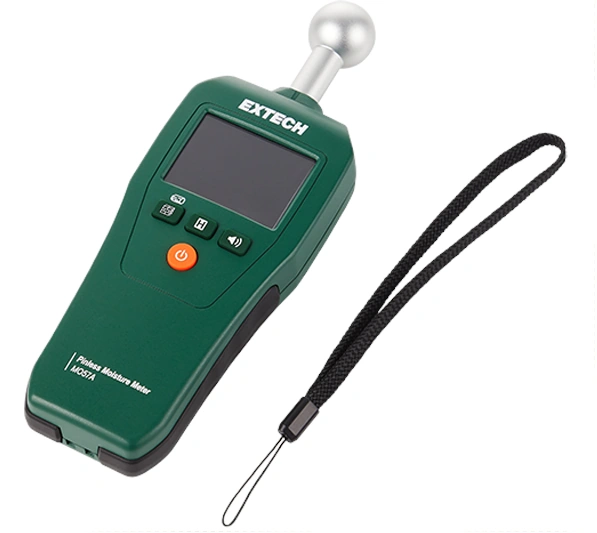
The MO57A is a pinless-only meter designed for quick surveys. Its standout feature is the ball probe sensor, which glides easily across surfaces for rapid readings.
- Measures moisture without damaging surfaces
- Scans deeply (up to ~4 inches / 102 mm)
- Ideal for detecting hidden moisture behind walls and floors
👉 Best for: building inspections, leak detection, and large-area scanning
🟡 MO55A – The versatile all-rounder
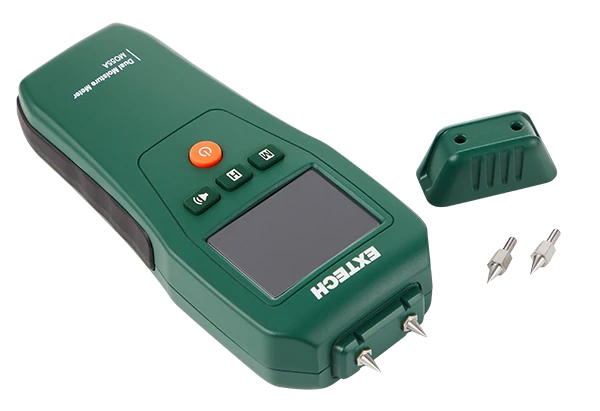
The MO55A combines both technologies in one tool:
- Pinless mode for quick, non-invasive scanning (up to 25 mm depth)
- Pin mode for accurate moisture percentage readings
- Covers both wood and building materials
👉 Best for: contractors or inspectors who need flexibility in one device
🔵 MO50A – Simple and precise
The MO50A is a straightforward pin-type meter:
- Uses replaceable 8 mm probes
- Provides true moisture content readings (WME)
- Accurate for wood and materials
👉 Best for: woodworking, flooring, and precise spot measurements
Expanding Your Toolkit with the Extech BR95 (with BR95-RH Sensor)
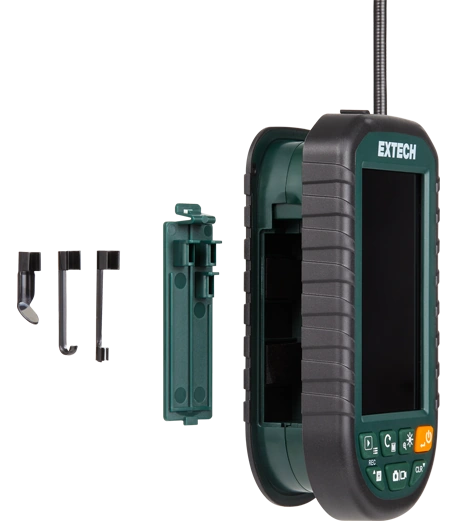
While moisture meters detect water inside materials, environmental conditions such as temperature and humidity often explain why moisture problems occur in the first place.
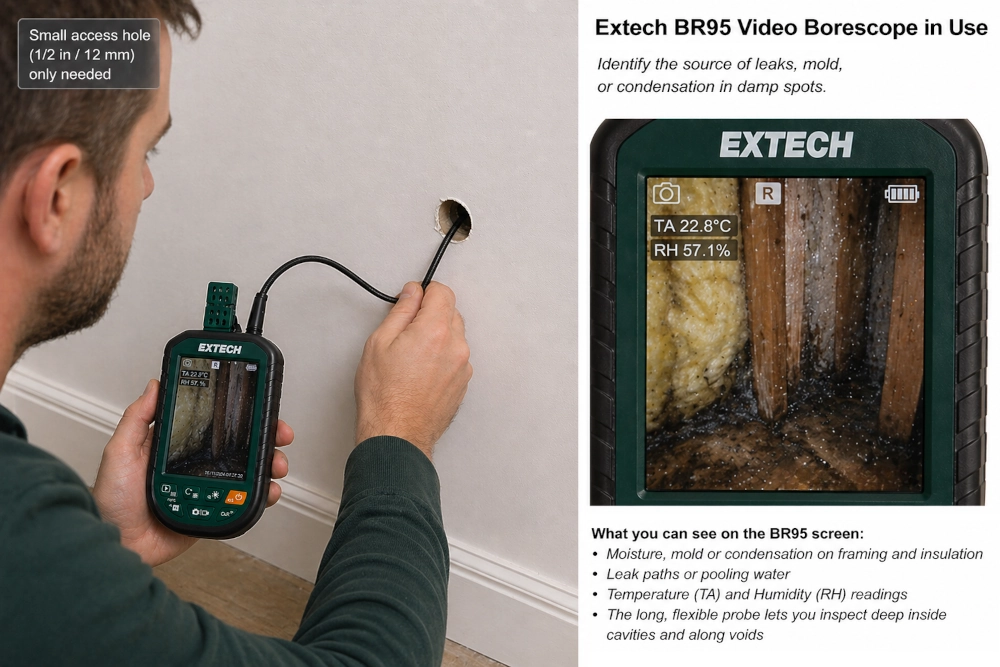
The Extech BR95-RH External Temperature and Humidity Sensor is designed to work with the BR95 borescope, allowing users to measure ambient conditions in hard-to-reach areas.
- Measures temperature from -40°C to 85°C
- Measures relative humidity from 0% to 100%
- Helps identify condensation risks and hidden moisture sources
- Supports early detection of mould and air quality issues
This type of sensor is especially useful when inspecting wall cavities, ducting, or enclosed spaces where trapped humidity can lead to long-term damage.
👉 Best for: identifying environmental causes of moisture problems, not just the symptoms
The Takeaway
All three meters are reliable—but they serve different purposes:
- Choose MO57A if you want fast, non-destructive scanning
- Choose MO55A if you want one tool that does everything
- Choose MO50A if you need simple, accurate readings for wood
In practice, many professionals actually use two types together: a pinless meter to locate moisture, and a pin meter to confirm it. The MO55A essentially combines both workflows into one device.
For a complete moisture inspection workflow, combining a moisture meter with environmental sensing tools like the BR95-RH can help identify both the presence and the cause of moisture issues.