Why Early Detection Is Critical for Electrical Asset Reliability
Detect Earlier. Respond Faster. Protect Critical Electrical Assets.
Electrical systems are the backbone of modern industry. Whether you're operating a manufacturing plant, utility network, data centre or renewable energy facility, reliable electrical infrastructure is essential.
One of the biggest threats to that reliability often begins long before equipment fails.
Partial discharge (PD) is an early warning sign that insulation within high-voltage electrical equipment is starting to deteriorate. Left undetected, it can lead to equipment damage, costly downtime and serious safety risks.
For many years, maintenance teams have relied on routine inspections to identify these developing faults. Advances in acoustic imaging have made those inspections quicker, safer and more accurate than ever before.
But one challenge has always remained.
What happens between inspections?
Partial discharge doesn't follow a maintenance schedule. It can begin at any time and is often intermittent, making it difficult to detect during a planned inspection.
That's why continuous monitoring is becoming an increasingly important part of modern predictive maintenance.
Understanding Partial Discharge
Partial discharge is a localised electrical discharge that occurs when insulation begins to weaken.
Rather than causing immediate failure, it slowly damages the insulation system. Over time, repeated discharges accelerate deterioration until the insulation can no longer withstand normal operating voltages.
Common causes include:
- Ageing insulation
- Moisture ingress
- Surface contamination
- Mechanical stress
- Manufacturing defects
- Installation issues
Detecting partial discharge at this early stage allows maintenance teams to investigate the cause and plan repairs before significant damage occurs.
The Cost of Waiting
The consequences of undetected partial discharge extend well beyond replacing damaged equipment.
A developing fault can result in:
- Unplanned outages
- Emergency maintenance
- Damage to switchgear or transformers
- Production downtime
- Reduced asset life
- Increased safety risks
For facilities where electrical reliability is business critical, even a short interruption can have a significant operational and financial impact.
Early detection gives organisations the opportunity to move from reactive repairs to planned maintenance.
Why Periodic Inspections Have Their Limits
Portable acoustic imaging cameras have transformed electrical inspections by allowing engineers to quickly locate ultrasonic emissions associated with partial discharge.
However, every inspection provides only a snapshot of equipment condition.
Imagine a switchboard inspected in January. Everything appears healthy. A few weeks later, insulation begins to deteriorate and intermittent partial discharge develops. By the next planned inspection, what started as a minor defect may already have become a costly failure.
As FLIR explains in its guidance on acoustic imaging, partial discharge often produces ultrasonic emissions long before a thermal camera detects a temperature rise. Detecting these ultrasonic signatures earlier gives maintenance teams valuable time to investigate and intervene before insulation failure occurs.
Continuous monitoring closes that inspection gap.
The Shift to Continuous Monitoring
Predictive maintenance has evolved considerably over the last decade.
We have moved from reactive maintenance to scheduled inspections.
The next step is continuous condition monitoring.
Instead of asking:
"When should we inspect this asset again?"
Maintenance teams can now ask:
"Is this asset healthy right now?"
That change allows developing faults to be identified as soon as they appear, reducing the likelihood of unexpected failures and helping maintenance teams make better-informed decisions.
Introducing the FLIR Si2a-PD
The FLIR Si2a-PD Fixed Acoustic Imaging Camera has been designed specifically for permanent monitoring of electrical assets.
Installed on critical infrastructure, it continuously monitors for partial discharge, corona and arcing without relying solely on routine inspections.
Using 124 low-noise MEMS microphones, AI-enhanced analysis and automatic partial discharge classification, the camera detects, locates and assesses developing faults in real time. It can automatically identify surface discharge, internal discharge, corona and floating discharge while providing AI-based severity assessments to support maintenance planning.
The system integrates with FLIR AssetLink, allowing maintenance teams to incorporate acoustic monitoring into a wider asset health programme.
Simply put, it's always listening.
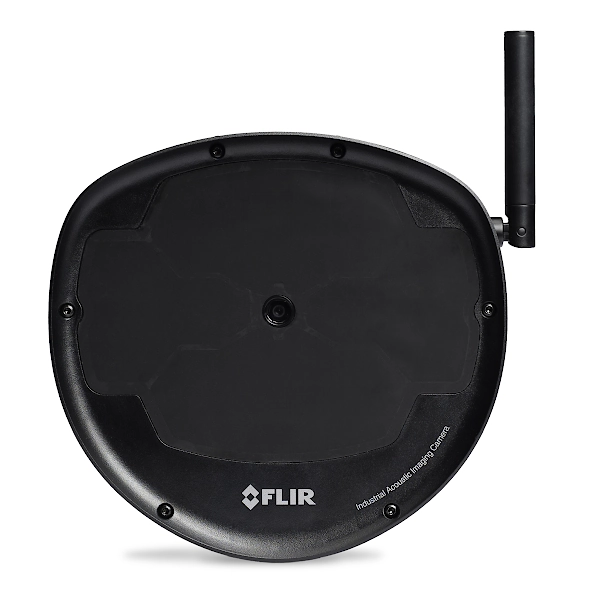
Continuous monitoring helps protect critical electrical infrastructure around the clock.
The FLIR Si2a-PD provides permanent acoustic monitoring for critical electrical assets.
Built for Critical Infrastructure
The Si2a-PD has been developed for demanding industrial and utility environments where electrical reliability is essential.
Key features include:
- Continuous 24/7 monitoring
- Detection of partial discharge, corona and arcing
- AI-assisted fault analysis
- Automatic PRPD pattern recognition
- Detection distances of up to 200 metres
- IP66-rated protection
- Power over Ethernet (PoE)
- REST API integration
- Compatibility with FLIR AssetLink
These capabilities help maintenance teams identify developing faults earlier while integrating seamlessly into existing condition monitoring programmes.
Where Continuous Monitoring Adds Value
Continuous partial discharge monitoring is particularly beneficial for:
- High-voltage switchgear
- Medium-voltage switchgear
- Gas Insulated Switchgear (GIS)
- Electrical substations
- Manufacturing facilities
- Data centres
- Utility infrastructure
- Renewable energy installations
Where equipment failure isn't an option, continuous monitoring provides an additional layer of protection.
A Smarter Approach to Asset Reliability
Modern maintenance isn't about finding faults.
It's about preventing them.
Continuous partial discharge monitoring gives maintenance teams the information they need to respond earlier, reduce operational risk and extend the life of critical electrical assets.
For organisations looking to strengthen their predictive maintenance strategy, permanent acoustic monitoring offers a practical way to improve reliability while reducing the risk of unexpected failures.
Discover the FLIR Si2a-PD with Acutest Direct
At Acutest Direct, we help organisations improve reliability through innovative condition monitoring technologies.
The launch of the FLIR Si2a-PD Fixed Acoustic Imaging Camera marks an important step forward in electrical asset protection, giving maintenance teams continuous visibility of their critical electrical infrastructure.
Because when it comes to partial discharge, the earliest warning is often the most valuable.