FLIR TG268 – 24:1 Spot IR Thermal Imaging Camera
- Complete with Bullseye Laser and Type K Thermocouple
- Accurate, reliable and built for professional diagnostics
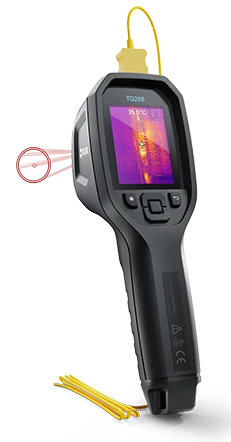
The FLIR TG268 is a compact and rugged FLIR Thermal Camera that helps you quickly locate heat-related faults, verify repairs and capture clear thermal evidence. It combines true thermal imaging with precise non-contact spot measurement, giving you a significant upgrade over a standard IR thermometer.
If you want a dependable FLIR IR Camera for electrical, mechanical, automotive or HVAC work, the TG268 provides the clarity and measurement certainty professionals rely on.
Get in touch today for pricing and expert advice.
Why Choose the FLIR TG268?
The FLIR TG268 bridges the gap between simple temperature guns and full-featured thermal imagers. It gives you the ability to see heat patterns, identify problem areas and document your findings in seconds.
FLIR TG268 Key Features:
- FLIR MSX image enhancement that adds visual edge detail to thermal images for improved clarity
- Accurate measurement up to 400°C (752°F)
- 24:1 distance-to-spot ratio for precise targeting
- Integrated Type K thermocouple input for direct contact temperature readings
- Class 1 bullseye laser that highlights the exact measurement area
- Rugged IP54-rated housing that withstands dust, moisture and two-metre drops
- Internal storage for images, thermal videos and data logs
- Wireless sharing via Bluetooth with the FLIR METERLiNK app
FLIR METERLiNK app
The FLIR METERLiNK app is a Bluetooth-enabled mobile tool that allows you to simultaneously monitor up to seven compatible FLIR meters for real-time tracking of electrical and environmental conditions.
It features a user-friendly dashboard with live graphical and numerical data, customisable high/low alarms, and the ability to compare multiple log files for efficient troubleshooting.
Fast Fault Identification
The thermal imager allows you to instantly spot overheating components, insulation issues and heat-loss points that a standard IR thermometer cannot reveal.
Professional Thermal Clarity
The 160 × 120 IR sensor produces sharp thermal images. MSX blends visible detail onto the thermal picture, making cables, components and structures easier to interpret both in the field and during reporting.
Accurate Targeting
The 24:1 distance-to-spot ratio keeps measurements accurate even when working on small components or scanning from a safe distance. The bullseye laser outlines the region being measured so you always know precisely where the sensor is aimed.
Dual Temperature Measurement
The TG268 includes a Type K thermocouple input, allowing you to take both non-contact IR readings and direct contact measurements. This is ideal for low-emissivity surfaces, fast verification checks and applications requiring physical temperature reference.
Built for Real-World Environments
The IP54 enclosure protects against dust and splashing water. The rugged construction is drop tested to two metres, making it suitable for workshops, plant areas, rooftops and industrial sites.
Typical Applications:
- Electrical inspection and troubleshooting
- Mechanical and rotating equipment monitoring
- HVAC system analysis
- Automotive diagnostics
- Building inspection and thermal surveying
- Production line process monitoring and quality control
Technical Specifications (TG268)
Thermal Imager
| Specification | Details |
| IR Resolution | 160 × 120 pixels |
| Super Resolution | Enhanced to 320 × 240 |
| Thermal Sensitivity | <50 mK |
| Field of View | 44° × 57° |
| Colour Palettes | Iron, Rainbow, White Hot, Black Hot, Arctic, Lava |
Temperature Measurement
| Specification | Details |
| IR Temperature Range | –25°C to 400°C |
| Accuracy | ±2.5% or ±2.5°C |
| Distance-to-Spot Ratio | 24:1 |
| Emissivity | Adjustable 0.10 to 0.99 |
Type K Thermocouple (TG268 Only)
| Specification | Details |
| Temperature Range | –30°C to 390°C |
| Display Mode | Real-time dual IR and thermocouple temperature |
Storage and Connectivity
| Specification | Details |
| Internal Storage | 8 GB eMMC |
| File Types | JPEG images, thermal videos, data logs |
| Connection Type | USB-C for charging and data transfer |
| Wireless | Bluetooth for sharing and mobile display |
Durability
| Specification | Details |
| Environmental Rating | IP54 |
| Drop Resistance | Two metres |
| Operating Temperature | –10°C to 45°C |
What comes with the FLIR TG268?
- FLIR TG268 Thermal Imaging Camera
- Type K thermocouple probe
- USB-C cable
- Wrist lanyard
- Quick start guide
❓ Frequently Asked Questions (FAQ)
Q1: Is the FLIR TG268 suitable for electrical inspections?
A. Yes. The thermal imaging capability and MSX detail make it excellent for identifying hot connections, overloaded circuits and developing faults.
Q2: What is the difference between the TG268 and TG298?
A. The TG268 includes a thermocouple input and measures up to 400°C. The TG298 does not include a thermocouple but can measure up to 1080°C using its high-temperature mode.
Q3: Can the TG268 record video?
A. Yes. It can capture thermal video along with temperature data for later analysis.
Q4: Does the TG268 store images internally?
A. It has 8 GB of internal storage, capable of holding tens of thousands of thermal images and numerous videos.
Q5: Is the TG268 durable enough for industrial use?
A. Yes. It is IP54-rated and drop tested to two metres, suitable for demanding environments.
Q6: Does it support Bluetooth sharing?
A. Yes. You can wirelessly share images, logs and readings through the METERLiNK app.